
The only three things you need to know about being an organized audience development blogger with an editorial schedule
Creating a robust editorial schedule for your blog isn’t only about making sure that your categories are getting published in regularly. It’s also not about fulfilling the need of all the different types of readers that come to your site. And it’s not even just about writing quality content.
If you manage content, your editorial schedule is where you have the opportunity to organize all of the content you will produce for the next pre-determined amount of time. It could be a week, but more likely it’s about a month, or a quarter. You probably have an email calendar too, which is closely related.
However, there are many different ways that you can slice and dice an editorial calendar so that you’re truly creating something new every time that you post.
[text_ad]
1. Chop up your editorial calendar by category
In order to evenly space out your blog posts, you’ll want to start the calendar by sorting your blog categories into days. Below is an example from a popular health publisher and what their editorial calendar looks like:
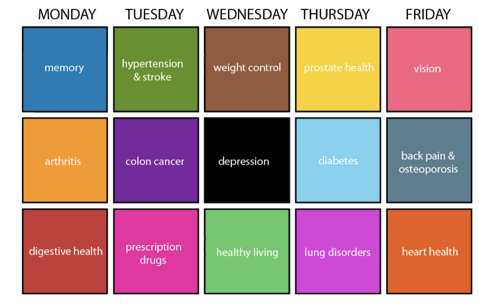
By starting with your categories, you will know exactly how long an editorial cycle will last. In the case of the above editorial calendar, you’ll see an editorial cycle that lasts three weeks and then repeats, because they have 15 categories and only post Monday through Friday.
[text_ad]
2. Define the different types of blog posts
We post several different types of blogs here at the Mequoda Daily, and I’m sure you’ll see the same thing across other blogs. The three that we publish on a regular basis are:
Evergreen SEO Post: The main job of an SEO blog post is to build organic traffic from search engines. These posts are newly optimized for keywords.
Blockbuster Post: This is one of our top 200 posts driving traffic to the website. We recycle these posts regularly by updating one per weekday, making sure that the posts driving all this traffic, keep driving traffic.
News Post: A news post is used to provide relevant, up-to-date information on your industry. You find content you like, written by your favorite sources, add value with original commentary and analysis and link to the original article. This is great material to post on social networks because it brings the reader to your website, before you point them back to the original article.
By mixing up these three types of posts, you’ll find that you’re satisfying many of your internal needs.
3. Mix up your blog formats
Your blog is going to get terribly boring if you’re writing a monologue each and every day. Successful bloggers understand the importance of mixing up your blogging style in order to attract different types of readers.
Start making lists: People are attracted to a well-formed list because they’re easy to skim. Being able to use a number in your blog title is also more attractive because it tells the reader that they’re going to get a certain number of take-aways and no fluff.
Source the news: News-worthy content is often quick and short, but it can be controversial and explosive. Often times, a comment on a news article can spur its own conversations and keep your website in front of the readers even longer. Watch Google News and Trends to stay on top of news in your industry.
Learn the art of the advertorial: You have products to sell don’t you? They have lots of content in them, don’t they? These types of posts are your opportunity to excerpt from those products and ignite an interest in the user to buy them. Remember, editorial integrity comes first, the sale comes second.
Make friends: If there are people in your industry that you can interview, or books in your niche that you can review, then get to it. By building relationships with these people, they’re more likely to link to you and forward your article onto their own network. It’s like you’re writing a testimonial, and everyone likes to share those.
Use photos: Any type of skimmable article is easily read, and photos make this easy. If you’re in a niche where photos are easily used, then take advantage. Using photos to break up an article is smart because people like to skim articles as much as they like to share beautiful photographs.
There. Have we sparked any new ideas today?
Begin with your categories to define just how long an editorial cycle is. Next, give it a kick in the pants by defining the formats in which you intend to write those articles. When people come back to your blog time and time again, they’ll be less likely to prefer a book over your word-heavy monologue.
This article was originally updated in 2011 and is updated frequently.





Thanks Latrisha! 🙂
Okay, so this is probably the best post I’ve ever ready on doing your editorial calendar. I’ve already started to work on using this to spice up my editorial calendar. Thanks that I found this post. Good job!